


It can be challenging to determine the factors driving Donald Trump a month into the US and Israel's programme of strikes on Iran.
However, it remains apparent he has his attention fixed on the oil markets.
A word – or online message – from the US president regarding his plans once would trigger big moves in prices, as traders reacted to signs the tensions could escalate or conclude.
However, in the last week, market players seem to be growing more doubtful about the significance of his remarks.
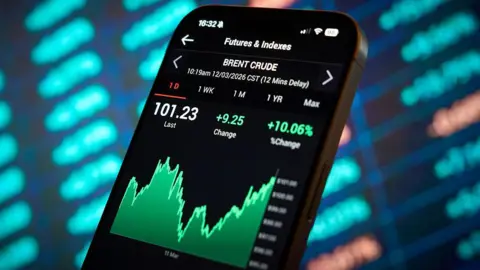
The price of oil was trading at around $72 a barrel before 28 February, when the strikes on Iran commenced.
Recently, it peaked at $118 a barrel on 19 March and by Friday afternoon was trading at slightly under $112 – significantly higher than its pre-war price.
The following are several examples from the last month where Trump and the markets appear to have bounced off each other – with varying effects.
Navigate with the navigation button to proceed to the next slide.
"Oil prices have become a proxy for broader political and financial risks, jumping when Trump's tone grows aggressive and declining when his rhetoric becomes more conciliatory," observes one market analyst.
He states that financial markets are appropriately attuned to those messages, given the significant macroeconomic threats that come with increasing oil prices.
"Traders are trying to price authentic uncertainty," he comments. "The markets can appear nervous or bewildered, but what they're actually doing is handling geopolitical risk in live, with oil acting as the centre of that."
However, it can be difficult for traders to figure out how to trade, particularly because some of Trump's comments seem aimed at affecting oil prices, rather than communicating official strategy, says another market commentator.
"As the saying goes, the first casualty of conflict is truth," he says. "My belief is much of the communication trading of statements around productive talks, and the contrary, very much are focused on merely moving the price of oil."
Market Reactions Grow More Muted
On a recent Thursday, moments after US stock markets experienced their largest decline since the beginning of the conflict with Iran, Trump said discussions with Iran were going "extremely well" and he was postponing planned attacks on Iran's oil facilities until at least 6 April.
Yet, the price of crude proceeded to rise.
One currency strategist points out that investor responses are "showing less volatility" because of the "significant disconnect" between Trump's optimistic statements and the absence of response from Tehran.
"In light of the appearances, a large number of market watchers do not foresee an quick conclusion to the hostilities and markets continue to be apprehensive."
Another investment director says investors have also adapted to Trump "repeatedly shifting position at indications of geopolitical, equity market or economic trouble".
"There is a amount of wariness, or even downright distrust, creeping in at the edges," he adds.


